

INTRODUCTION
My Story: Why This Matters
I failed the first time I went private. I was 23, barely 10 months certified, confident because my clients at 24 Hour Fitness loved me. I had no leads, made no money, and watched trainers I thought were worse than me stay booked solid. I didn't prepare. No working website. No onboarding systems. Just training knowledge and frustration. That experience stuck with me, giving me a fear of taking my business private again.
Thankfully, I got hired to teach at National Personal Training Institute. That was my parachute. I worked there for 15 years.
When the school closed in March of 2023, I was unemployed for the first time in 15 years. I had to make money fast, so I bet on myself again—personal training, full time. It was terrifying. I remembered how badly it went last time. But I didn't have a plan B worth taking. This time, I got support. I built systems. I slowly grew the business.
Then in October 2023—five months after being laid off—the gym I trained at closed. I moved my business to another gym and kept building.
Then in October 2024, that gym closed too.
Laid off. Two gym closures. Eighteen months.
My business never took a hit. My client intake and retention systems were resilient. I want to share the systems I built so you can do it too, no matter what happens around you.
It's common for independent trainers to be great at training, yet struggle to get clients. This happens because your passion and education is in assessments, program design, and coaching—not marketing, advertising, sales, business development, website development, search engine optimization, or Google Ads.
However, to be an independent trainer, we must not just learn to feed ourselves, but first plant the seeds, grow the crops, and harvest the fruits of our labor.
Besides resigning, training is almost the end of the client acquisition funnel. It's important to understand each part of the process to improve the quality of leads, eliminate choke points, and reduce resistance along the way.
What Is a Client Acquisition Funnel?
The client aquisition funnel is the systematic path someone takes from not knowing you exist to becoming your client. It starts wide—many people could potentially be interested—and narrows down to the few who actually hire you. Each stage of the funnel serves a specific purpose: to move someone closer to becoming a client by providing information, building trust, and setting expectations.
The key word is "flow." A funnel only works if people move smoothly from one stage to the next. If someone gets stuck or confused at any stage, they drop out and you lose them. Your job is to understand what happens at each stage, remove friction, and make the next step obvious.
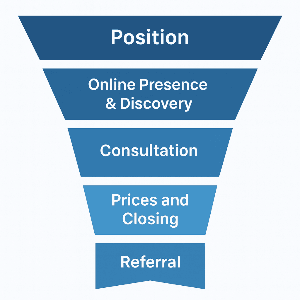
How the Funnel Heats Up the Lead
A prospect doesn't instantly go from cold to ready to buy. They need to move through stages where you gradually warm them up—introducing yourself, explaining what you do, showing why you're different, and building trust.
Stage one: They discover you exist (online presence, referral, word of mouth). They learn your positioning—who you help and what problem you solve. This is the introduction.
Stage two: They learn more about your process and what to expect (website, consultation description, pre-consultation questionnaire). This sets expectations and primes them.
Stage three: They have a consultation where you demonstrate your approach and show them you understand their specific situation. This builds trust and rapport.
Stage four: They decide to work with you because they've been gradually informed and have clear expectations.
Each stage provides information. Each stage sets expectations. Each stage removes doubt. By the time someone reaches a consultation, they're not meeting you cold—they already understand what you do and why they should care.
Without this funnel, you're asking strangers to make a decision based on nothing. With it, you're guiding people through a logical progression where they learn, evaluate, and decide.
Why Flow Matters
A prospect won’t jump from "I've never heard of you" to "I'm hiring you." There are stages in between and skipping them costs you clients. If your website doesn't clearly explain your process, prospects won't know what to expect from a consultation. If you don't respond quickly, they lose interest before they even meet you. If you don't set expectations about cost or commitment, they ghost when they realize what's involved.
Each stage depends on the previous one working well. Your online presence brings them in. Your website explains what you do. Your scheduling system removes friction. Your questionnaire primes them. Your consultation closes them.
This presentation will review each component of the funnel, overcome typical challenges, and offer actionable suggestions to discover your brand, heat up the lead, and build business.
POSITIONING
The Foundation: Problem, Solution, Delivery
Positioning starts with clarity on three things: what problem you solve, what your solution is, and how you actually deliver it. Most new trainers skip this and try to appeal to everyone. That doesn't work when you have zero credibility. You need to pick a specific problem and own it.
What Problem Are You Solving?
This is the starting point, not the end point. The problem can't be "I want to get fit"—that's too vague and everyone already knows that's a possibility. The real problem is deeper.
The problem has two layers: the physical issue and the emotional pain it creates. Most trainers stop at the physical layer. That's a mistake. People don't hire trainers just because their knee hurts—they hire trainers because their knee hurts and now they can't play with their kids without getting winded and feeling useless. They don't hire you because they want to get stronger—they hire you because they feel aimless wandering around the gym and embarrassed to go into the weights section because they don't know what to do.
The emotional pain is what actually drives the decision to hire you. The physical problem is just the mechanism.
Some examples of the full problem (physical + emotional):
A desk worker can't sit for 8 hours without back pain, and they're frustrated that they're only 35 but feel like they're falling apart. They're worried they're permanently damaging their body and don't know how to fix it.
A busy parent can't find time for the gym, and they feel guilty watching their health slip while taking care of everyone else. They're frustrated that they know what they should do but can't figure out how to make it fit into their life.
Someone wants to lift weights but feels intimidated walking into the strength section of the gym. They're embarrassed they don't know proper form and frustrated watching other people confidently move through exercises they don't understand.
The difference between a vague problem and a specific one is huge. "Get fit" appeals to nobody. "Stop waking up with lower back pain from sitting all day and feeling like your body is breaking down in your thirties" appeals to the person experiencing it. Your job is to identify both the physical problem your ideal client has and the emotional pain that comes with it—the frustration, embarrassment, guilt, or confusion that's actually keeping them up at night.
When you're clarifying your positioning, you usually pick a problem because you either experienced it yourself or you've seen it repeatedly in people around you. Maybe you had tendonitis and remember the frustration of not being able to train the way you wanted. Maybe your sister struggled with postpartum fitness and you saw her guilt about not "bouncing back." Maybe you were overweight and remember the embarrassment of not knowing where to start. That personal connection to both the physical and emotional sides of the problem makes your positioning authentic and credible.
What Is Your Solution?
Your solution is NOT "I'll train you." That's what every trainer offers. Your solution is the specific approach or outcome you're offering.
For example, if the problem is "I can't find time to exercise as a parent and I feel guilty about my health slipping," the solution might be "40-minute sessions twice a week that fit your schedule, no gym required, you can do it at home—so you can take care of yourself without sacrificing time with your family." Or if the problem is "I want to lift weights but I'm embarrassed because I don't know what to do in the weights section," the solution might be "a structured beginner program that teaches you proper form step-by-step, so you can walk into any gym with confidence." Or if the problem is "I sit all day with back pain and I'm worried I'm permanently damaging my body," the solution might be "a movement assessment that identifies what's causing your pain, plus corrective exercises you can do at your desk to fix it throughout the day."
The solution should directly address both the physical problem and the emotional pain. If someone's problem is guilt about not having time, your solution better remove that guilt by making it time-efficient. If someone's problem is embarrassment from not knowing what to do, your solution better build confidence through education and structure. Most new trainers offer the same generic solution to everyone (hourly training sessions) and wonder why different people aren't equally interested.
Your solution also includes the outcomes you're promising. What will actually change for them? Not "you'll be fitter" but something more specific: "You'll be able to play with your kids without getting winded" or "You'll walk into the gym knowing exactly what to do" or "You'll sit through an 8-hour workday without back pain." The outcome should be something they actually care about, not something you think they should care about.
How Do You Actually Solve It?
This is where most trainers get vague. "I'll create a program tailored to you" sounds good but doesn't explain anything. How do you actually solve the problem?
This is your methodology or process. It's the specific steps or approach you use that makes your solution actually work. It answers the question: what do you actually do with someone that results in the problem being solved?
For instance, if your positioning is "I help desk workers eliminate back pain and stop feeling like their body is falling apart," the "how" might be: "First, I assess your posture and movement patterns to identify the root cause. Then, I teach you corrective exercises specific to your imbalances. Finally, we build those corrections into your workday so you're fixing the problem while sitting, not just during sessions." That's concrete.
Or if your positioning is "I help busy parents who feel guilty about their health get strong without sacrificing family time," the "how" might be: "We train twice a week for 40 minutes at home using minimal equipment. I design programs around compound movements that give you the most results in the least time. You get stronger without adding another obligation to your schedule." Again, specific.
Or if your positioning is "I help people who feel intimidated by the gym learn to lift weights with confidence," the "how" might be: "We start with basic movement patterns—squat, hinge, push, pull—and build your technique before adding weight. I teach you how to assess your own form and progress exercises. After 8 weeks, you'll have a program you can run independently in any gym." Concrete and reassuring.
The "how" is what separates you from someone else claiming to solve the same problem. It's also what you can talk about naturally in conversations, which matters when you're getting your first clients through word-of-mouth and referrals, not ads.
Putting It Together: Your Positioning Framework
For a from-scratch trainer, your positioning statement should answer these three things clearly enough that someone could repeat it back to a friend: "My trainer helps [type of person] solve [specific problem] by [specific approach/method]."
Some examples to see how this works:
"I help desk workers who sit all day eliminate back pain by assessing their movement patterns, teaching corrective exercises specific to their imbalances, and building those corrections into their workday so they're fixing the problem while sitting."
"I help busy parents who feel guilty about their health get strong in 40-minute sessions twice a week at home, using compound movements that give them results without sacrificing family time."
"I help people who feel intimidated by the gym learn to lift weights with confidence by teaching basic movement patterns, building technique before adding weight, and giving them a program they can run independently."
Notice that each one identifies who (desk workers, busy parents, intimidated gym-goers), what problem (back pain from sitting, guilt about health slipping, intimidation from not knowing what to do), and how (movement assessment and workday corrections, time-efficient home training, structured technique-building). That clarity is what gets your first clients.
Why This Matters for Growing Your Business
Clear positioning is your foundation for client acquisition. Without it, you're competing with every other trainer in your area who offers "personalized training." With it, you own a specific problem and become the obvious choice for people experiencing it.
Clarity signals competence. A trainer who can clearly articulate the problem they solve and their approach sounds like they know what they're doing. A trainer who says "I help anyone get fit with whatever works for them" sounds confused.
Additionally, clear positioning makes word-of-mouth work. When someone you know asks their friend "do you know a good trainer?", the friend can only recommend you if they remember specifically what you do. "My trainer helps people with back pain" is memorable and shareable. "My trainer is pretty good at fitness" is forgettable.
Your positioning also makes all your marketing easier. Your website, social media, consultations, and referral conversations all become simpler when you can clearly state who you help and what problem you solve. Generic positioning forces you to explain yourself constantly. Specific positioning does the work for you.
ONLINE PRESENCE & DISCOVERY
People will search for you online before they commit. Your online presence needs to be consistent, clear, and professional. Think of it as a funnel: discovery platforms get attention, then direct to your website where you tell your complete story.
Your Website
This is your hub where you control the narrative. You need a simple one-page site (WordPress, Wix, or Squarespace—2-3 hours to set up) that answers four questions: Who you help. What problem you solve. How you solve it. How to contact you.
That's it. Keep it simple and clear. Someone should land on your site and immediately know if you're the right trainer for them. Your positioning statement should be consistent across all platforms, but your website is the only place where you have full control.
Discovery Platforms
Google Business Profile and local directories (Yelp, Thumbtack) serve one purpose: get people to your website.
Google Business Profile is free and shows up in local searches. Include your positioning, contact info, hours, location, and a direct link to your website. Keep it updated and professional. Use the same differentiators here that you use on your website. If your website says "I teach you to assess your own form and progress exercises independently," your Google Business Profile should mention that too.
Local directories help with discoverability. Pick one or two that make sense for your market, include your positioning and location, and link to your website. Again, repeat your key differentiators. Someone reading your Thumbtack profile should see the same unique value propositions they'd see on your website.
Building Reviews Systematically
Reviews are your social proof. Target 2 reviews per week from current and past clients. After 3 months, you'll have 24 reviews. After 6 months, you'll have 48. That's credibility.
Ask for reviews when someone is happy—after they've seen a win or completed their first month. Make it easy with a simple text template and direct link.
Text template: "Hey [name], thanks for being great to work with. I'd really appreciate a quick review on [Google/Yelp] so other people know what to expect. Here's the link: [link]. Takes about 30 seconds. Thanks!"
Reviews live on Google Business Profile (most important), then Yelp or Thumbtack. Feature a few of your best reviews on your website to reinforce trust.
Consistency Across Platforms
Your messaging must be consistent across your website and all discovery platforms. This isn't about copy-pasting the same text everywhere—it's about repeating the specific things that differentiate you from other training options.
Identify 2-3 differentiators that make your approach unique and valuable. These could be things like "get clear, real-time feedback on technique," "programs tailored to your specific movement limitations," "gain confidence and expertise, not just follow instructions," "learn the why behind every exercise," or "fix the problem at your desk, not just in sessions."
Whatever differentiates your approach, repeat it everywhere. Your website should say it. Your Google Business Profile should say it. Your directory listings should say it. When someone sees the same key phrases across multiple platforms, it reinforces your positioning and makes it memorable.
This repetition serves two purposes. First, it creates consistency—someone who finds you on Google and then visits your website should feel like they're learning about the same trainer, not reading two different stories. Second, it builds credibility—when you consistently emphasize the same strengths, people believe you actually deliver on them.
Most trainers make the mistake of writing generic descriptions for each platform: "personalized training," "helping you reach your goals," "customized programs." These phrases don't differentiate you because every trainer says them. Your differentiators should be specific enough that another trainer couldn't claim them without changing how they actually work.
Go back through your website, Google Business Profile, and directory listings. Make sure your 2-3 key differentiators appear on all of them. This isn't redundancy—it's strategic reinforcement of what makes you different.
FREE CONSULTATION / TRIAL
The prospect has arrived on your website and has been enticed to learn more. They email you sharing their goals and asking what's next. This is a critical transition moment—they're interested but not committed. Your job is to get them excited about the consultation and actually show up prepared to invest.
The First Response: Build Excitement and Remove Friction
When someone emails expressing interest, your response sets the tone for everything that follows. Don't just reply with logistics—build excitement while making the next step easy.
Your first response should do three things: acknowledge their specific situation (reference what they mentioned in their email), explain what they'll get from the consultation (not what you'll do TO them, but what they'll learn and gain), and make booking effortless (direct link to your scheduler, not "let me know what works for you").
Example responses:
Client: I would like to build muscle and have more energy.
Response: Hi! It's Mark Bransky, the personal trainer you emailed. I would love to help you build muscle and have more energy. When are you available for a consultation?
Client: I would like to lose 20lbs and learn exercises.
Response: Hi! It's Mark Bransky, the personal trainer you emailed. I would love to help you lose 20lbs and learn exercises. When are you available for a consultation?
These responses show you listened (mirror their exact language), express enthusiasm about helping with their specific goals, and immediately move toward booking. Simple, direct, and focused on their desired outcome.
Speed of Response
Respond to inquiries within 24 hours (sooner is better). Book the consultation within 48 hours (also sooner is better). This is your first opportunity to signal professionalism and responsiveness. Slow response feels unprofessional, even if you're just busy.
Fast response also captures them while they're motivated. Someone who emails you today is thinking about their problem today. If you respond three days later, they've moved on mentally and you've lost momentum.
Use Scheduling Software
Calendly or similar tools eliminate the back-and-forth of "what time works for you?" This removes a common friction point where prospects get tired of messaging and disappear. Give them options (3-4 specific slots per day) rather than asking them to suggest times.
Scheduling software has built-in features to improve your process. Use workflows and reminders to inform and remind prospects about the consultation. This is where you start preparing them for success.
Confirmation and Reminders: Prepare Them for Success
Once they schedule, the confirmation email and text reminders should inform and prepare them for the session. The more they anticipate what to expect, the more comfortable they will be, the higher the likelihood they show up and invest in training.
Uncertainty creates anxiety. Anxiety kills commitment. Your job is to remove uncertainty by giving them information.
Your scheduling software sends a confirmation email immediately after they book. Use this confirmation to tell them exactly what to expect. Include: what you'll do during the consultation, what they'll learn or gain from it, what to bring or wear, how long it will take, and where to meet (with parking instructions if relevant).
The confirmation should explain the structure of the session so there are no surprises. If you're doing a movement assessment, say so. If you'll be teaching them exercises, mention that. If it's a 45-minute session that includes discussion followed by movement screening, spell it out. Don't assume they know—be explicit.
Frame the consultation as valuable whether they decide to train with you or not. This reduces pressure and makes them more likely to show up. Something like: "You'll leave with a clear understanding of what's causing your [problem] and what needs to happen next. This isn't a sales pitch—it's about giving you real value."
Tell them what to wear (comfortable clothes they can move in) and what to bring (usually nothing—you have what's needed). These details remove decision points and reduce pre-session anxiety.
Text reminders should reinforce preparation, not just logistics. Your scheduling software can send automatic reminders 24 hours before the appointment. Use this reminder to emphasize what they'll accomplish: "Looking forward to our consultation tomorrow at [time]. We'll be assessing your movement patterns to identify what's causing your [problem]. Wear comfortable clothes. See you then!"
This reminder keeps them thinking about the value they'll receive, which increases show rates. It's not just "don't forget"—it's "here's what we're going to accomplish together."
Pre-Consultation Questionnaire
Link your questionnaire directly in your scheduling software so prospects fill it out immediately after booking. The answers help you understand who you're meeting, their goals, limitations, and readiness before you ever sit down together.
The questionnaire serves multiple purposes: it gives you important health and safety information before the consultation, it saves time during the consultation so you can focus on solving their problems rather than learning about them, and it gives prospects time to think about what they actually want from training.
What to Include in Your Questionnaire
Your questionnaire should cover three areas: health history, goals, and lifestyle.
Health history includes standard questions required for liability and proper program design. Ask about diagnosed diseases or conditions that require doctor clearance. Include PAR-Q (Physical Activity Readiness Questionnaire) items like chest pain during physical activity, dizziness or loss of consciousness, bone or joint problems, current medications, past injuries, or any other health concerns. These answers tell you if you need medical clearance before working together and alert you to limitations you'll need to work around.
Goals help you understand what they're trying to accomplish and why it matters to them. Ask what their primary goal is and why it's important. Ask what's held them back in the past. Ask what success looks like to them. These answers give you context for the consultation and help you connect their problem to your solution.
Lifestyle questions help you tailor your approach to fit their reality. Ask about their work schedule and commitments. Ask if they've worked with a trainer before, and if so, what they liked and what they would have liked different. This question is gold. It tells you what to repeat (they liked detailed explanations, they liked being pushed hard, they liked flexibility with scheduling) and what to avoid (their last trainer talked too much, didn't listen, was late to sessions, made them feel judged). You can address their preferences proactively during the consultation: "I saw you mentioned your last trainer didn't explain the why behind exercises. I make sure to walk you through the reasoning so you understand what we're doing and why it matters."
Why This Matters
The questionnaire matters for several reasons.
First, it saves valuable time during the in-person meeting. Instead of spending 15-20 minutes asking about health history, goals, and schedule, you can jump straight into assessment and problem-solving. The consultation becomes about delivering value, not collecting basic information.
Second, it creates a record of important information. You have written documentation of their health conditions, medications, past injuries, and stated goals. This protects you legally and gives you a reference point you can return to throughout your work together. When they say "I never told you about my shoulder injury," you have their questionnaire that says otherwise.
Third, it primes the client for a productive session. Filling out the questionnaire forces them to think about their goals, limitations, and what they actually want. They arrive having already reflected on their situation, which means they give you better answers during the consultation. Someone who filled out a questionnaire an hour before meeting you is more prepared than someone walking in cold.
Fourth, it limits surprises. You know about their knee surgery before you ask them to squat. You know they have high blood pressure before you program high-intensity intervals. You know their last trainer was always late, so you make sure you're early. Walking in informed means you can plan appropriately and avoid awkward moments that damage credibility.
When you walk into a consultation already knowing their health history, goals, and lifestyle constraints, you're not starting from zero. You're starting informed, which lets you deliver immediate value and demonstrate that you've done your homework.
The Consultation Itself
The setup and scheduling creates the right conditions for a productive consultation. You've set expectations about what to expect (from your website description and confirmation email), you've collected information in advance (questionnaire), you've prepared them mentally (reminders that build anticipation), and you're meeting quickly while they're motivated (fast booking).
By the time they arrive, they're comfortable, informed, and ready. They know what's going to happen, they've thought about their goals, and they're not walking in blind. Now the consultation is about understanding their situation, demonstrating your expertise, and presenting your solution—not overcoming anxiety or confusion about what they signed up for.
Follow Through on What You Promised
The flow of the consultation should match exactly what you advertised online and prepared them for in emails and texts. If you said you'd do a movement assessment, do the movement assessment. If you said you'd perform body composition analysis, do it. If you mentioned you'd teach them corrective exercises they can use immediately, teach them those exercises.
No surprises, only follow-through.
Consistency between what you promise and what you deliver is what closes consultations. If your website says "I'll assess your posture, identify imbalances, and teach you an exercise," then your consultation better include posture assessment, identification of imbalances, and teaching an exercise. That's not repetition—that's integrity.
Explain As You Go
Most people who seek trainers don't know what they're doing in the gym. Everything is foreign. They feel like imposters. Your job during the consultation is to narrate the entire practical portion so they understand what you're doing and why it matters. People opt out of things they don't understand or don't feel a part of.
Walk them through the structure of the session before you start. "Here's what we're doing today: First, I'll have you move through a few basic patterns—squat, hinge, push, pull—so I can see how your body moves and where the limitations are. Then I'll explain what I'm seeing and how it connects to your goal. Finally, we'll do a sample workout based on what I found, so you can feel what training with me looks like."
This preview eliminates anxiety and gives them a roadmap. They know what's coming and why.
Narrate the Assessment
As you assess their movement, explain what you're looking for and what you're seeing. Don't just watch them squat in silence—tell them what you're observing and why it matters.
"I'm doing this assessment so I can see what muscle imbalances are causing compensation. Watch what happens when you go down—your lower back is excessively arching. That tells me that your hip flexors may be tight and your glutes may be weak. We have to address this with lengthening and strengthening exercises before we load this pattern with weight."
"When you hinge at the hips, your lower back is doing most of the work instead of your glutes and hamstrings. That may be why you feel back pain when you bend over to pick things up. We need to improve your movement so your back isn't carrying the load."
Every movement pattern you assess should be explained in terms of what you see, why it's a problem, and how it connects to their goal or pain point.
Connect Assessment to Program Design
Once you've assessed their movement, explain how what you found will shape their program. This is where you show them you're not just going through motions—you're using a systematic approach.
"Based on what I saw, here's how we'd build your program: Every session we will start by lengthening your tight muscles with flexibility training, then strengthening your weak ones with core training. Then we will do a total body resistance circuit. The first month will work on stability and control. Then we will progress to increase strength by loading the movements we just stabilized."
This explanation does several things. It shows them you have a plan. It shows them the plan is based on their specific limitations, not generic programming. It gives them a timeline so they know progress takes months, not days. And it demonstrates expertise—you're not just making it up as you go.
Run a Sample Workout
After explaining the assessment findings and program approach, take them through a short sample workout. This lets them feel what training with you is actually like.
Before you start, frame it: "We're going to do a 15-minute sample of what a session looks like. I'm going to have you do a few exercises that address what we found in the assessment. I'll coach you through each one and show you what good form feels like."
During the workout, continue narrating. "This exercise targets your glutes and hamstrings—the muscles that should be doing the work when you hinge. Feel how your hips are moving now instead of your lower back? That's what we're training."
"I'm cueing you to pull your shoulders back because we need to retrain that pattern. Every rep, think about squeezing your shoulder blades together. That's building the strength you need to hold better posture at your desk."
The sample workout should directly relate to their goal. If their goal is to eliminate back pain, the exercises should address the movement limitations causing the pain. If their goal is to build muscle, show them exercises that target the areas they want to develop. If their goal is to feel confident in the gym, teach them foundational movements they can do anywhere.
Make Them a Participant, Not a Spectator
When people understand what's happening and feel included in the process, they buy in. When they don't understand or feel like a passive observer watching something foreign happen to them, they opt out.
By the end of the consultation, they should understand: what movement limitations they have, why those limitations matter, how you'll address them, and what training with you feels like. That understanding creates buy-in. They're not signing up for something mysterious—they're committing to a process they understand and have already experienced.
FIRST CLIENT DELIVERY
Closing the Sale: From Consultation to Commitment
The consultation went well. They understand your approach, they see how you solve their specific problem, and they're interested. Now you need to actually close the deal and get them started.
This transition matters because it's where many trainers lose momentum. The prospect is warm but not yet committed. Your job is to remove the final friction points and make starting easy.
Before you present your package, confirm frequency and schedule alignment. There's no use pitching three times per week if their availability doesn't match yours. Ask: "Based on what we talked about, I'd recommend training two to three times per week to get the results you want. What does your schedule look like? Which days work best for you?" Listen to their answer and see if it aligns with your availability. If they say "I can only do Tuesdays and Thursdays at 6am" and you're not available then, you need to know that before you pitch. If their schedule works with yours, now you can present a package that fits their reality.
There is a structure to presenting prices and overcoming objections that we won't discuss in detail in this presentation. The key principle is clarity and directness—state your pricing, explain your structure, and address concerns honestly without discounting your value.
Some prospects will commit immediately. Others need time to think about it. That's fine—just set a clear next step. "Take a day or two to think about it. I'll follow up on Thursday to see if you have questions." Then actually follow up when you said you would. Many trainers lose clients simply because they never circle back.
If cost is a barrier, you can offer flexibility (payment plans, shorter blocks), but don't discount your services just to close the deal. That sets a bad precedent and attracts clients who won't value your time. Instead, acknowledge the investment and reinforce the value: "I understand it's an investment. The reason we work in 8-week blocks is because that's how long it takes to build real, lasting change. Shorter than that and you're not giving yourself enough time to see results."
ASK FOR REFERRALS
Building the Foundation for Referrals and Testimonials
Every client interaction is an opportunity to set up your future client acquisition. Every session, every check-in, every win you help them achieve should be setting the stage for referrals and testimonials down the line.
DELIVER EXCEPTIONAL RESULTS
This is obvious but worth stating: if your clients don't get results, nothing else matters. Focus on solving the problem you promised to solve during their consultation.
If you said you'd eliminate their back pain, track their pain levels weekly and adjust your approach if it's not improving. If you said you'd help them build strength, measure their strength progressions and make sure they're actually getting stronger. Results are the foundation of everything else.
BUILD TRUST THROUGH COMMUNICATION AND CONSISTENCY
Clients refer people they trust. Trust comes from showing up on time, doing what you said you'd do, and being responsive when they have questions.
It also comes from being honest. If something isn't working, say so and adjust the plan. If they need something you can't provide, refer them to someone who can. Trustworthiness matters more than perfection.
CREATE MOMENTS WORTH TALKING ABOUT
Clients refer trainers when they have something specific to say. Generic good experiences don't get shared—memorable ones do.
This could be a breakthrough moment (they did a movement they thought was impossible), a particularly insightful explanation (you connected their pain to a habit they didn't realize mattered), or a gesture that showed you care (you remembered a detail from a past conversation and followed up on it). Look for opportunities to create these moments intentionally.
PLANT REFERRAL SEEDS EARLY WITHOUT BEING PUSHY
You don't ask for referrals in the first month—that's too soon. But you can mention that you work best through word-of-mouth and are always looking to help more people with their specific problem.
Something casual: "Most of my clients come from referrals. If you know anyone dealing with [specific problem], feel free to send them my way." This plants the idea without making it a formal ask.
When and How to Ask for Referrals
After the first month, when clients have experienced results and built trust with you, it's time to make the actual ask. The key is timing—piggyback referral and testimonial requests after significant moments, sessions, or breakthroughs.
These moments are when clients are emotionally high and the proof of your value is fresh in their mind. They just hit a personal record. They just moved without pain for the first time in months. They just completed a workout they couldn't have done four weeks ago. They're proud of themselves and grateful to you. That's when you ask.
The ask should be direct but natural. Right after acknowledging their win, transition to the referral request. "I'm so glad you hit that milestone—this is exactly the progress we've been working toward. If you know anyone else struggling with [specific problem], I'd love to help them the same way I've been able to help you."
This works because you're asking when they're most likely to say yes. They're experiencing the result of your work in real time. They're not being asked to remember how they felt weeks ago—they're feeling it right now. The value is undeniable in that moment.
Combine the referral request with a testimonial request while the win is fresh. "Would you mind leaving me a quick review on Google sharing what you just accomplished? It helps other people understand what's possible." Then immediately follow with the referral ask: "And if you know anyone dealing with back pain like you were, I'd love to help them too."
Asking for both at the same time is efficient and natural. The testimonial captures the win in their own words, which you can use for social proof. The referral request plants the seed that they should be actively thinking about who in their network might benefit from training with you.
Don't wait for a perfect moment to materialize on its own. Create regular opportunities to acknowledge wins and make the ask. Every month, there should be something worth celebrating—a strength increase, a mobility improvement, a pain reduction, a habit successfully built. Celebrate it, then ask.
What to Do When You Receive a Referral
When someone refers a prospect to you, act quickly and acknowledge both parties.
First, thank the person who made the referral. A quick text or email: "Thanks for referring [name] to me. I really appreciate you thinking of me." This reinforces that referrals are valued and makes them more likely to refer again in the future.
Second, reach out to the referred prospect within 24 hours. Speed matters—referrals are warm leads, but they cool down fast if you don't respond. When you contact them, mention who referred them: "Hi [name], [referrer] mentioned you might be interested in training. They said you've been dealing with [problem]." This establishes immediate credibility and context.
Third, move them into your standard consultation funnel. Referred prospects still need to go through the same process—website, scheduling, questionnaire, consultation. Don't skip steps just because they were referred. The funnel exists to set expectations, prime them for success, and demonstrate your systematic approach. A referral gets you in the door faster, but the consultation is still where you close the deal.
The goal of asking for referrals is not just to get names—it's to create a systematic process where happy clients naturally think of you when someone in their network has the problem you solve. When that happens, you respond quickly, acknowledge the referrer, and guide the prospect through your proven funnel. That's how one client becomes many.
DIAGNOSING FUNNEL BOTTLENECKS
You want the core insight without the analysis deep-dive. Here's the stripped-down version:
Client Acquisition Funnel: Chokepoints & Fixes
The Three Biggest Leaks
1. Response Speed & Scheduling (kills 30-40% of prospects)
Problem: Slow replies, back-and-forth messaging, confusing scheduling
Fix: Use scheduling software (Calendly). Respond within 24 hours. Book within 48 hours.
Time to implement: 30 minutes
2. Unclear Positioning (kills qualified prospects before they contact you)
Problem: "Personalized training" messaging applies to every trainer. Prospects don't know if you're right for them.
Fix: Write one clear sentence: "I help [specific person] with [specific problem] so they can [specific outcome]."
Time to implement: 1 hour
3. Weak Consultation Execution (kills 30-40% of those who show up)
Problem: Trainer talks too much, doesn't connect assessment to their goal, no clear ask for commitment
Fix: Structure it—5 min connection, 25 min movement demo, 10 min clarity & ask
Time to implement: 1 hour to script, then practice
Quick Wins (Do These Next)
Automate reminders → 20% fewer no-shows
Create follow-up protocol → Stop prospects from going cold between inquiry and consultation
Track your funnel → Find out where YOU'RE actually losing people (not where you think)
- The pattern: Most trainer funnel problems aren't skill gaps. They're system gaps. Fix the systems first, then improve execution.
- Start here: Which stage loses the most prospects—before they book, after they inquire, or after the consultation?
CONCLUSION
Building a business is like making a mountain of paint one layer at a time. You don't create a perfect funnel overnight. You build it incrementally—one improvement, one system, one fixed friction point at a time. Each layer makes the foundation stronger.
A business is never fixed. It's a living animal that needs attention and adjustment over time. What works today might not work next year. Client expectations shift. Competition changes. Your positioning evolves as you get clearer about who you serve best. The consultation structure that closes 50% of prospects this quarter might need refinement next quarter. That's not failure—that's reality.
The key is knowing what to keep and what to reiterate. Keep what works. When prospects are booking consultations consistently, don't change your response system. When consultations are converting at a high rate, don't reinvent your structure. But when prospects are dropping out at a specific stage, that's where you focus your attention. Reiterate what doesn't work until it does.
The client acquisition funnel helps you conceptualize a broader process and identify areas to focus on to improve business development. Without this framework, you're guessing. You're trying random tactics without understanding where the actual problem is. With this framework, you can diagnose systematically: Are prospects not finding you? Not booking? Not showing up? Not committing after the consultation? Each stage has specific fixes.
Start with one thing. Fix your positioning. Speed up your response time. Restructure your consultation. Automate your reminders. Don't try to overhaul everything at once. Pick the biggest leak in your funnel and patch it. Then move to the next one.
Your business grows one layer at a time. Keep building.